In 1935 Enterprise argued about tearing the EM&M down; Wallowa County fixed the roof and built apartments inside instead. Ninety years on, the building is being fixed again, with 27 homes still upstairs.
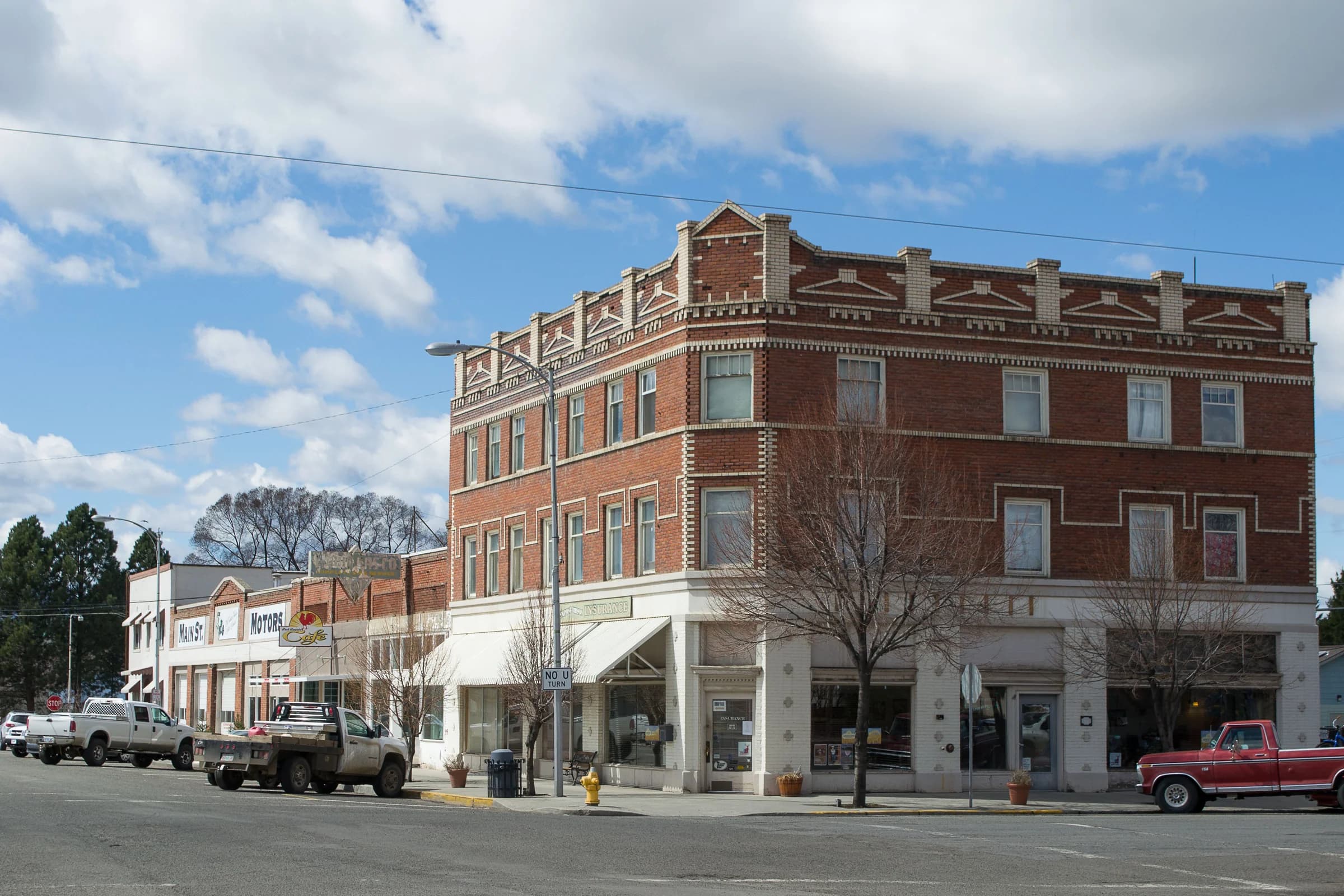
Enterprise’s downtown streetscape. Context photograph; the owner’s photographs of the EM&M itself are linked in the story.Visitor7 · 2013-04-09 · CC BY-SA 3.0 · Image & source ↗
In this story 5 sections
Documented history
1935: tear it down, or fix the roof?
In 1935 the EM&M was falling apart and expensive to keep. A newspaper editorial said the county should tear it down. The Chamber of Commerce called a meeting on the building's future and could not agree.
Wallowa County chose to fix it and put homes inside. The work started with the roof, paid for with county money and State Emergency Relief Administration labor. By September 1936, four apartments had been built on the mezzanine.
The building people walk past today is what that argument left behind. Neighbors looked at the same walls and reached opposite conclusions about what to do. The county's answer, spend public money and make shelter, is the one still standing.
What the record shows: the National Register nomination retells the 1935 fight from newspapers and county commissioner minutes of the time. Those original pages were not re-read for this story.
Working Homes says it bought the EM&M in July 2024. Its project page counts 27 apartments and six commercial spaces, and says the goal is to keep the apartments affordable. The same page names old wiring and mechanical systems as work that still needs money.
A September 2, 2026 report by Shannon Weidemann lists what is happening now. Wiring is replaced apartment by apartment, as each one empties out, so the people already living there are disturbed less. New heat pumps have gone in. Fire-safety planning is underway, and window restoration is expected to start in 2027.
Fixing apartments as they empty means the building holds homes at different stages at once. One unit may have new wiring and a heat pump while the one next door waits. A project announcement cannot tell a renter which repairs their own apartment has had.
A closer look
One building, several kinds of work
Homes
27 apartments identified in the project description; no claim that every unit is occupied.
Street-level economy
Six commercial spaces share the building and its long-term maintenance needs.
Building systems
Electrical and heating upgrades; fire-safety planning and future window work.
A conceptual guide to the published project, not a floor plan or an inspection. Owner account and September 2026 reporting.
What the record shows: the owner's undated project page, read September 2026, states its purpose. The 2026 report mixes finished work (heat pumps), ongoing work (rewiring) and planned work (windows, 2027); it does not say what any one tenant received.
“Keeping an apartment standing and keeping it affordable are two different jobs.”
Analysis
A fixed apartment is not always an affordable one
Keeping an apartment standing and keeping it affordable are two different jobs. Repairs keep the home there. Affordable depends on what the people in it earn, and what they pay for rent, heat, light and everything else they cannot skip. The test is simple: what did residents pay and get before the work, and what do they pay and get after?
A new heat pump can cut a power bill. A rent increase can eat the savings. A grant can pay for a repair so tenants do not carry the whole cost. Any of these could be true at the EM&M.
This is why counting new houses misses part of the housing story. Old homes need money to stay safe and usable. Track that money alongside new construction and you see work that otherwise shows up only when something breaks.
Enterprise and surrounding fields. This county context does not identify available housing or land approved for development. Sam Beebe · 2007-07-08 · CC BY 2.0 · Image & source ↗
What the record shows: neither the owner's page nor the 2026 report gives rents, utility bills or loan terms from before and after the work, so the effect on tenants' costs is not yet known.
The 2025 community health assessment ranks housing among the county's biggest needs. The people it interviewed call housing the biggest barrier to hiring workers. So a hard move is not only the renter's problem. It can become an unfilled job in a service the rest of the county depends on.
Childcare works the same way. A March 2025 research toolkit tells how Wallowa Memorial worked with a local childcare operator to open care for employees' families, with room for about 16 children. One employer took on one practical thing that kept people from working.
What the record shows: a March 2025 toolkit describes one employer's childcare arrangement in a short case study. It does not show that every family has care, or that childcare alone solved hiring.
The purchase and the repairs are on the record. What they mean for the people upstairs is not, yet. The 1930s do not settle today's project. They leave the same question the county faced then: what does it cost to keep homes usable, who pays, and what happens to the people living there? The building can stand while those answers change.
What are the rents, and have they changed since July 2024?
What conditions come with the grants and loans paying for the work?
What do the tenants themselves say?
Working Homes calls these the area's last non-subsidized affordable apartments. Compared with what, and counted how?
Sally Donovan and Adrienne Donovan-Boyd; National Park Service · Accessed 2026-09-13
Nomination received January 2012. PDF pages 15–16, City and County Intervention; section 7, architectural description. Historical reconstruction using newspaper articles and commissioner minutes; those underlying items were not separately examined for this edition. Building photographs credited to the preparers, summer/fall 2010; republication permission unverified.
Publication: undated. Locator: City of Enterprise; EM&M Building; paragraphs 1–3. Owner’s account; last remaining affordable claim is not an independently tested inventory.
Shannon Weidemann (McKone), Elkhorn Media Group · Accessed 2026-09-13
Publication: 2026-09-02. Locator: EM&M paragraphs and five-item Current upgrades list. Separate publication, but project account centers on Working Homes; no tenant interviews or independent completion inspection stated.
Oregon Office of Rural Health / Wallowa Memorial Hospital · Accessed 2026-09-13
2025 assessment; PDF pages 1–2, priorities, housing and care access. Survey estimates and key-informant perspectives, not a housing inventory or a referendum. Summary combines data from different reference years.
Robert Barclay et al., Flex Monitoring Team · Accessed 2026-09-13
Publication: 2025-03. Locator: Printed/PDF p. 5, opening Wallowa Memorial paragraph; p. 4 Quality of Life. Short case study, no item-level source for Wallowa interview or outcome statistics. PDF extraction contains an unrelated 2021 text layer; visible March 2025 title governs.
How to read the evidence
Documented history / Project record
What the cited records say happened, with their dates and their limits attached.
Reported experience
What a person or an organization said, credited to them and not treated as everyone’s experience.
Analysis
Our reading of the records. Argue with it through the sources it cites.
Open questions
What the record does not yet answer.
Every claim is held to the same standard. That does not make every claim equally well supported.
In October 2026 there were 79 homes for sale in all of Wallowa County, the most in years, and 17 of them cost less than $350,000. A two-bedroom rented for about $1,200 a month and a family house for $1,600 to $1,800. A new house cost about $375 a square foot to build, before anyone bought the land. A nurse who takes a job at the hospital has to live within twenty minutes of it. This is why that is hard, what the numbers can and cannot tell you, and what has been tried.