In 1995, the court papers from an 1888 murder trial turned up in a Wallowa County safe. Every record in this county was kept by someone, and every silence has a story too.
Enterprise in a postcard circa 1912. This photograph was made after the 1888 trial discussed below.Unknown photographer; digital restoration by Tim Davenport · circa 1912 · Public domain · Image & source ↗
In this story 5 sections
Documented history
The trial in Enterprise where no one was punished
In May 1887, Chinese miners were murdered near Deep Creek on the Snake River. The first report said ten men were dead. Historian Greg Nokes writes that the evidence points to as many as thirty-four.
The miners worked for the Sam Yup Company, and the company did not wait for someone else to notice. It sent Lee Loi to pursue the case. He hired Joseph K. Vincent, a Lewiston judge, to investigate. The Chinese consulate also pressed for action.
In 1888, six men were indicted. Three fled. Three stood a two-day trial in Enterprise and were acquitted on September 1, 1888. No one was punished for the killings.
The court papers surfaced in an unused county safe in 1995. In June 2012, a memorial to the miners was dedicated at the site. Told this way, the story is not a mystery that later historians happened to solve. It is a story of people who asked for justice and did not get it.
What the record shows: the count of the dead is uncertain, ten in the first report and as many as thirty-four by later evidence. Papers found in a safe in 1995 do not by themselves prove anyone hid them.
The courthouse in the photograph is the wrong building
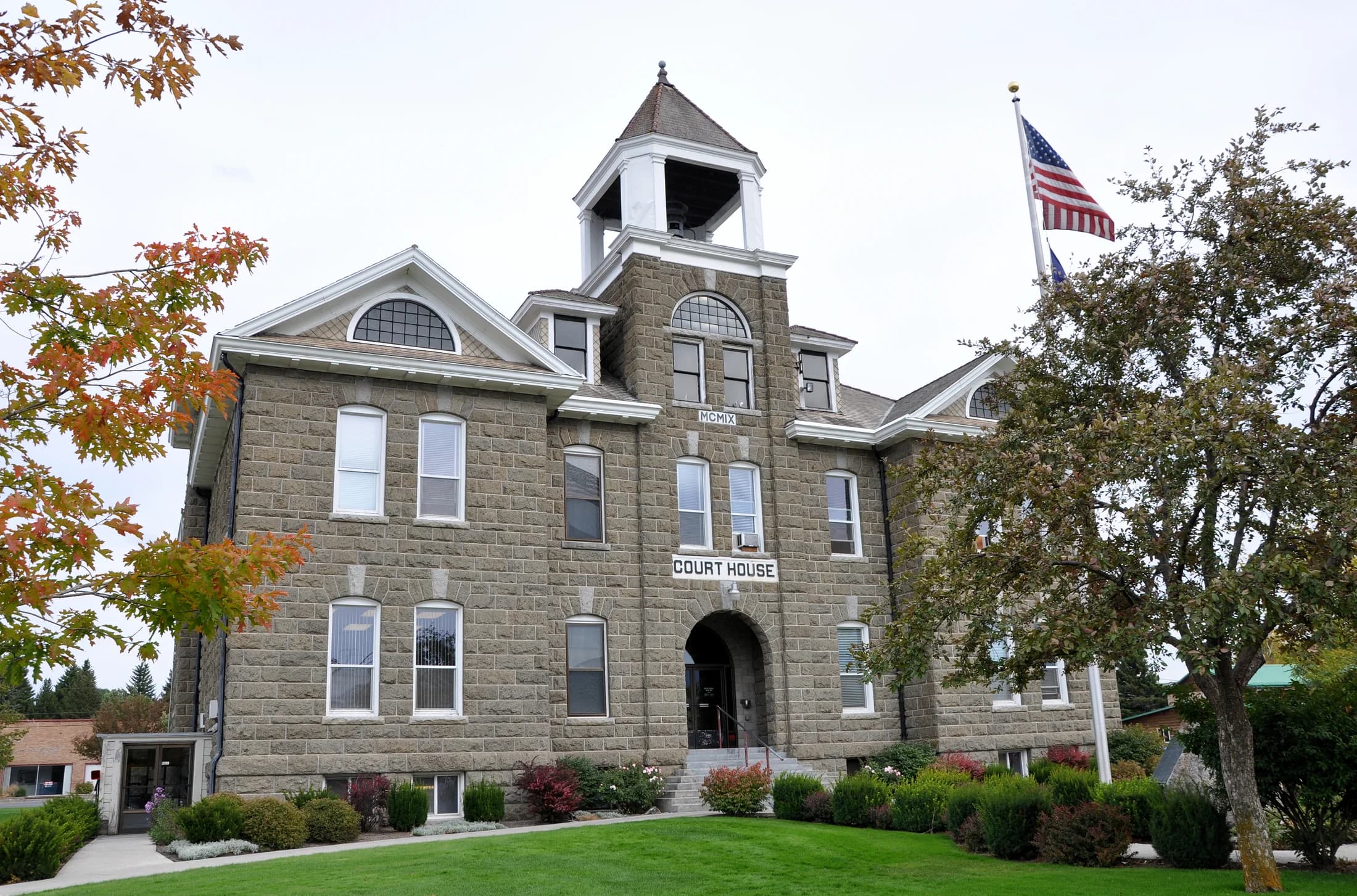
The Wallowa County Courthouse in Enterprise was built in 1909. The trial was in 1888. So a photograph of this courthouse is not a photograph of where the trial happened, however familiar the landmark looks.
A court file can prove that a trial took place. It cannot prove that justice was done. An acquittal is a verdict, not an account of everything that came before it. Testimony keeps details, but it also keeps the witness’s interests and the questions officials chose to ask.
Almost nothing is known about the miners beyond some names and their home district in China. Their families and journeys are missing. Where evidence exists, those lives should be recovered from it. Where it does not, no invented detail should stand in for a real person.
The Wallowa County Courthouse in Enterprise, photographed in September 2010. Built in 1909, this courthouse postdates the 1888 trial; it is not the trial’s setting. Finetooth · 2010-09-17 · CC BY-SA 3.0 · Image & source ↗
“It is a story of people who asked for justice and did not get it.”
Documented history
A petition to keep people out, and photographs of them coming back
In 1901, settlers signed a petition to keep tribal members from returning to the valley. Marilyn Hulse of the Wallowa History Center has written about it. About 400 men signed it, by her account. She has also written about the photographs of Benjamin Curtis, which show Nez Perce visitors in the lower valley in later years.
One record shows a wish to shut people out. The other shows people still coming. Neither cancels the other. A petition, a boundary and people’s actual movements are three different things. An institution can try to control access without ending a people’s tie to a place.
A caption added later may name someone the photographer never named. A written summary may paraphrase an official answer whose exact words matter. Each source holds up one part of the story, and it helps to know which part.
What the record shows: Marilyn Hulse’s accounts describe the petition and the photographs. The original petition, the government’s response and the individual photographs still need to be read in their own context.
Grace Bartlett’s papers, and the people who kept them
Rich Wandschneider has written about who keeps this county’s papers. In a 2012 essay, he described Grace Bartlett’s four file drawers of research and the archivists who came to look through them. In 2026, he wrote about the Wallowa History Center and the people behind it, among them Mary Ann Burrows, Marilyn Hulse and Linda Bauch.
A collection does not assemble itself. Someone finds the material, keeps it, sorts it and explains it. A letter saved in one house and thrown out in the next changes what the record seems to say. It says nothing about which life mattered more.
That makes preservation public work. It also gives a reader good questions to ask of any collection. Who donated? Who wrote the descriptions? Which communities were asked? Which records were too hard or too costly to keep?
The Wallowa History Center’s research guide points to newspaper collections and the Enterprise Library’s portal. Lostine’s event archive works at a smaller scale: notices about council business and everyday town life. In 2017 that meant a Grange potluck, a meeting about the closing transfer site and a postponed council meeting. Records like these can show how a place ran between the big events.
An advertisement proves that someone offered a product on a certain date. It does not prove the ad was true. A meeting notice proves that people meant to meet. Minutes, or someone’s account, tell you what happened.
The county’s history gets deeper when records are read side by side. Put the verdict beside the people who pushed for it, the petition beside the photographs, a public anniversary beside a family’s papers. The goal is not one flawless story. It is a story with its evidence showing, so the next person can question it, correct it and add to it.
Still open:
How many miners died at Deep Creek in May 1887, and who were they?
What did the 1901 petition say in its own words, and how did the government answer?
Who is in Benjamin Curtis’s photographs, and who wrote their names down?
Which local papers were never kept, and whose lives went unrecorded because of it?