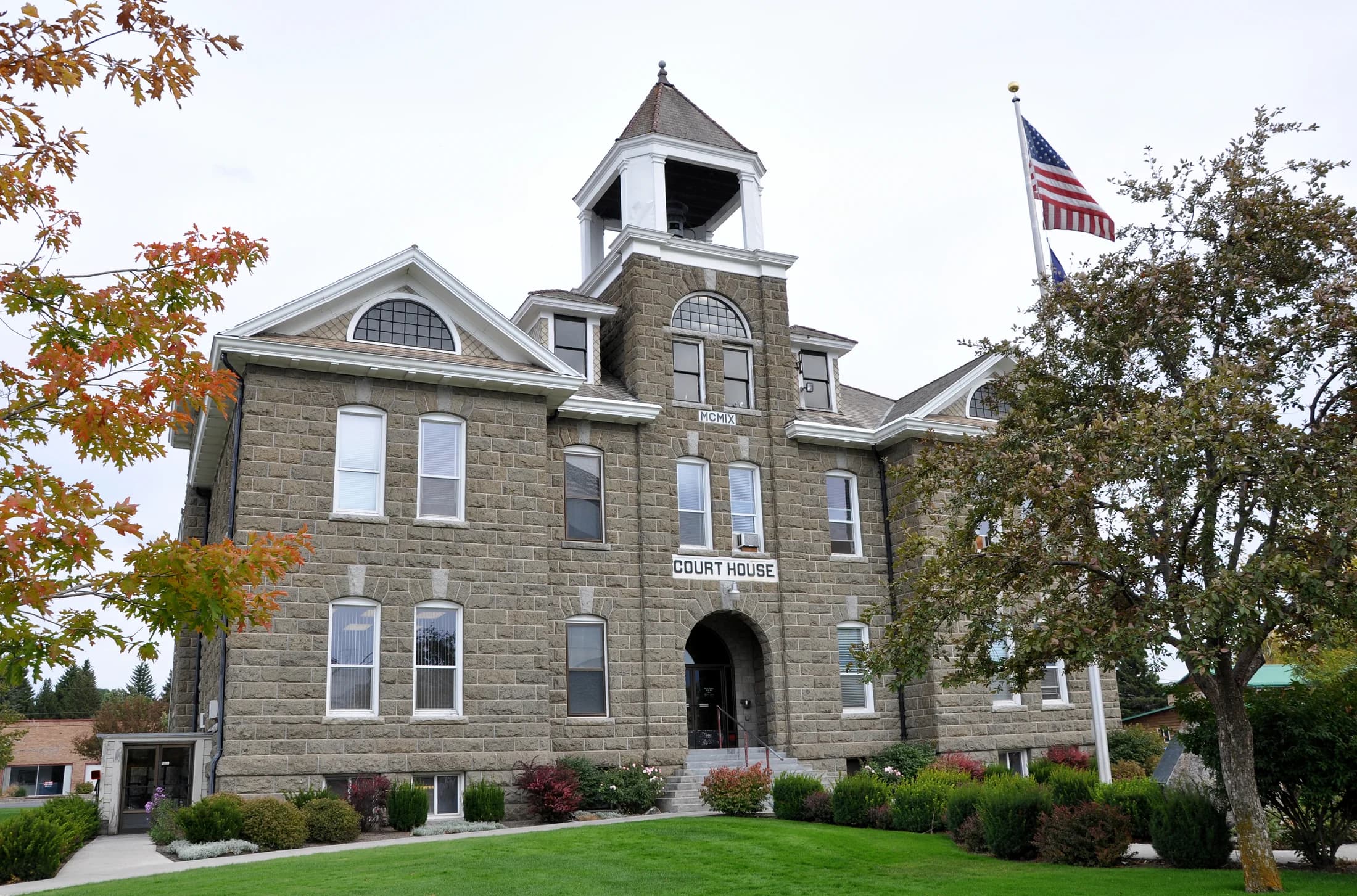
Wallowa County was separated from Union County in 1887. Joseph served as the interim seat until Enterprise won the 1888 election for it against Joseph and Lostine, and the county rented offices until the Bowlby-stone courthouse opened on South River Street in 1909. The county is governed by a three-member Board of Commissioners, elected by position, which meets on the first and third Wednesday of each month at 9:00 a.m. and states its purpose as assisting “in maintaining community well-being.” Its departments and offices run from the assessor, clerk, treasurer, sheriff and district attorney to the road department, public works, solid waste, public transit, land-use planning, building codes, public health, veterans services, emergency services and dispatch, community corrections, youth services, parks, the library, the museum and the Wallowa Lake county service district.
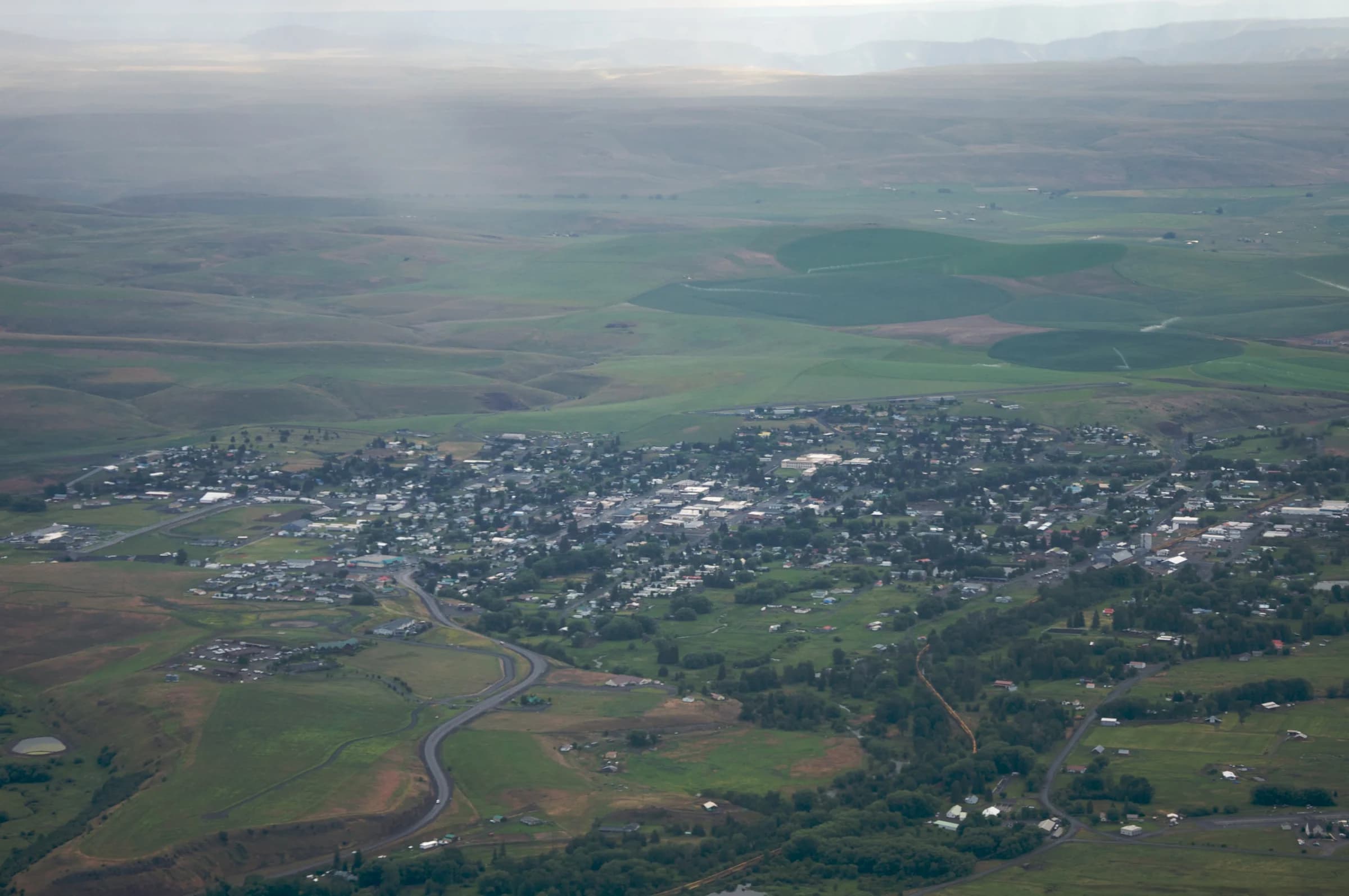
The county covers 3,146 square miles of land. Of that, 1,171,213 acres, about 58 percent by the Record’s arithmetic, is federal land on which the county levies no property tax. The census counted 7,391 people in 2020, after 7,226 in 2000 and 7,008 in 2010.
In 2026 the board is Lisa Collier, John Hillock and Cody Lathrop. In the May 19 primary, voters elected Lathrop, then the mayor of Enterprise, to Position 2 with 2,374 votes against 900 and 489 for his two opponents, and reelected Hillock to Position 3 with 2,140 votes to 1,563. Lathrop took the oath on July 1, 2026, from County Clerk Sandy Lathrop, succeeding Mike Hayward, who had joined the board in 2025 after Commissioner Susan Roberts died. The board divides the departments among its members. Lathrop’s list includes building codes, grant management, information technology, emergency management, search and rescue, veterans services, the museum and natural resources, with Enterprise and Lostine as his city liaisons; Collier oversees the road department, the landfill and recycling.
Not yet reviewed by the organization. This record was written from its published materials and the sources below. A correction from the organization changes the record the same day.
Where the county’s money comes from
The fiscal 2025 audit shows actual revenue of about $11.5 million across all county funds, and the adopted budget took budgeted positions from 72.35 to 62.71 full-time equivalents. Headwaters Economics’ Rural Capacity Index, a composite of staffing, education, broadband and similar measures, scores the county 54.8 of 100, 29th of Oregon’s 36 counties by the Record’s sort.
Two federal payments stand in for the property tax the county cannot collect on federal land. Payments in Lieu of Taxes were $690,395 in 2025 and $1,497,560 in 2026, on 1,171,213 acres. The formula deducts certain other federal payments from the year before, so the jump in 2026 reflects in part the lapse of Secure Rural Schools rather than new money. Secure Rural Schools, created in 2000 to replace the county’s share of federal timber receipts, lapsed from September 2023 to September 2025. Congress reauthorized it in December 2025, and the county received nearly $2.25 million in 2026 in three payments through October: 85 percent to the county road department and the school districts, 8 percent to natural-resource projects on public land, and 7 percent to public safety, mostly the sheriff’s office. The program’s funding expired again on September 30, 2026; a three-year extension was introduced in the Senate on October 1.
The county’s transient lodging tax is 5 percent of the rent on any motel or RV park stay of under thirty days, inside or outside the cities and including Wallowa Lake State Park, under the ordinance the county posts, approved April 5, 2004 and in force since July 2, 2004. It collected $612,998 in fiscal 2025, which implies a taxable base near $12.3 million. That division is the Record’s arithmetic, not a county figure.
Where the lodging tax goes
The ordinance says where the money goes. After collection costs, its guidelines send 20 percent to the hospital district’s ambulance service, 10 percent to Search and Rescue and 5 percent to the county’s solid waste program; 15 percent to tourism, recreation, economic development, parks or other county projects on the recommendation of a Transient Lodging Tax Review Board; and 50 percent to the Wallowa County Chamber of Commerce, which must budget at least half of its share for tourism and business development promotion. By the ordinance’s own terms, a third of the tax has gone to emergency services and solid waste since 2004, and a quarter is guaranteed to promotion.
Oregon requires that 70 percent of the net revenue of a local lodging tax adopted or raised after July 1, 2003 go to tourism promotion or tourism-related facilities; a tax in place before that date keeps its own split. House Bill 4148, passed in the 2026 session and effective June 5, 2026, lowers that floor to 50 percent from January 1, 2027. The county’s page labels its ordinance 95-005 and its registration form cites 2004-007, and the county reported this same split to a 2008 state survey for fiscal 2003-04, before the 2004 ordinance: the tax was in place on July 1, 2003, and by that rule the 70 percent floor has not governed it. The bill changes no rate; raising the county’s 5 percent would take a county vote. On October 14, 2026, the commissioners agreed in a work session to reassess the tax’s income and possibly put a change to voters, citing the cost of law enforcement after the Enterprise police department fell to two officers, and looked at a Chamber chart of what the county has received since 2003. At the fiscal 2025 base, each percentage point of the tax is worth about $123,000 a year, again the Record’s arithmetic.
From the lake, where most of the tax is collected, the complaint is about what it has bought. Calina Ide, president of the Wallowa Lake Tourism Association, says the lake’s businesses carry the lodging tax and that since the county’s lodging tax was set up for tourism infrastructure there has not been an investment at the lake for that purpose, although the tax was originally sold to lake businesses as a way to support and improve tourism infrastructure. “As far as I’m aware, nobody has asked for specific improvements at the lake,” she wrote, “other than last year when we asked the county to fund our website renovation from the TLT money, as it hadn’t been renovated since it was built 15-plus years ago. We received what we asked for.” She wrote those sentences for this record on October 29 and November 2, 2026.
In front of the board in 2026
On August 10, 2026, the sheriff’s office reported phone and internet service down across most of the county. 911 calls were rerouted and answered; according to EONI a damaged fiber line had been found by 11:15 a.m., and service was restored by 12:35 p.m. The notice gives no start time and names no cause beyond the damaged line.
On August 19 the board continued a discussion of opening the Ant Flat Landfill more days and hours, for demolition waste from the west side of Wallowa Lake and from the old county library in Enterprise, against the county’s cost; a work session was set for September 9. The same meeting adopted the commissioners’ liaison assignments.
On May 19, 2026, voters repealed, 2,044 to 1,319 in the election-night count, the 2023 measure that had required the commissioners to meet every February and August on moving the Oregon-Idaho border. The 2023 measure had passed by seven votes after the final count. The last required meeting was held on February 25, 2026.
What this record cannot yet tell you
How many residential tax accounts have their statements mailed outside the county, reported as a total with no names.
Lodging-tax receipts by month and building permits by year, in one place.
The list of grants the county and its four cities currently hold.
What a lapse in Secure Rural Schools would cost the road department and the sheriff’s office in fiscal 2027.
Also known as: Wallowa County · Wallowa County Board of Commissioners · the county
Through time
Wallowa County is separated from Union County; Joseph is the interim seat.
Enterprise wins the county-seat election against Joseph and Lostine.
The Bowlby-stone courthouse opens on South River Street after years of rented offices.
Secure Rural Schools is created to replace the county’s share of federal timber receipts.
A county measure requiring twice-yearly meetings on moving the state border passes by seven votes after the final count.
May 19: voters repeal the border-meeting measure, 2,044 to 1,319, and elect Cody Lathrop to Position 2.
August 10: a damaged fiber line cuts phone and internet across most of the county for part of a day.
September 30: Secure Rural Schools funding expires again.
January 1: up to half of local lodging-tax revenue may fund county services under House Bill 4148.